

Why Are LED Roll-Up Screens So Popular?
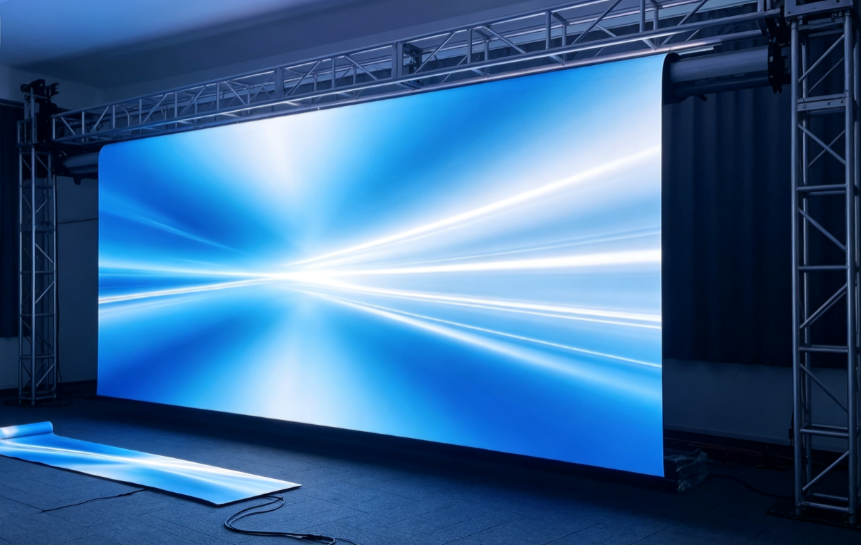
When a screen can be rolled up, unfolded, bent, and stowed away like a scroll, to what extent will the boundaries of spatial design be redefined? This is no longer just a conceptual vision—it is a reality being brought to life by the “LED roll-up screen.” As a prime example of “flexible displays” in the LED display industry, Yobole’s LED roll-up screen—with its unique ability to roll up, raise, and retract—is opening up unprecedented possibilities in commercial spaces, exhibition design, stage design, and other fields.
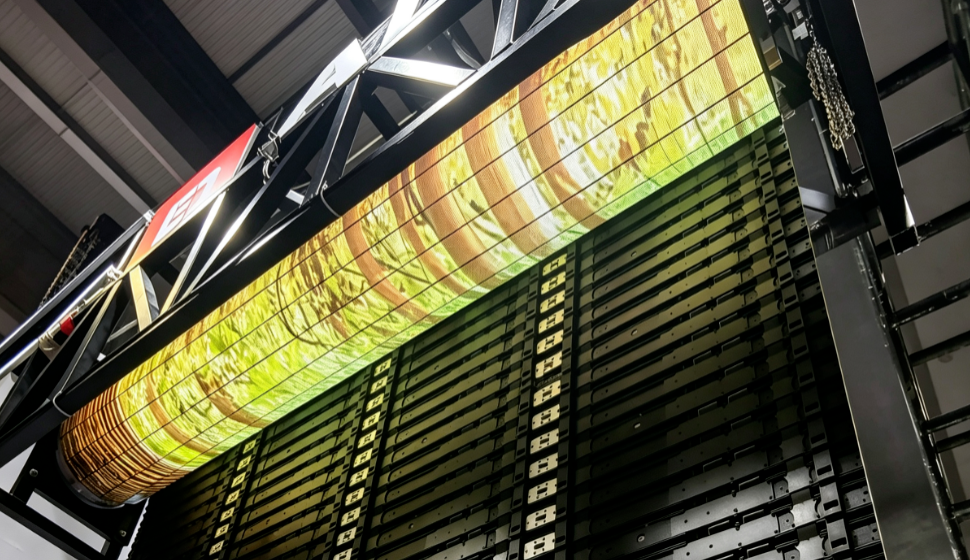
Understanding the “Rolling” and “Unrolling” of LED Roll-Up Screens
The key to an LED roll-up screen’s ability to roll up for storage lies in the flexibility of its materials. It uses thin-film substrates or flexible materials such as polymers to replace traditional rigid PCBs, mounting LED chips and driver circuits onto a bendable substrate. The LED modules are interconnected via flexible circuits, with electrical signals transmitted through conductive traces printed on the substrate to power the LEDs and control their brightness and color.
From a structural design perspective, multiple display modules are connected in sequence via rotating joints, forming an interlocking structure similar to a roll-up door. This allows the screen to undergo multidimensional deformations, such as 360-degree vertical rolling and 90-degree horizontal folding. This design completely breaks through the physical limitation that traditional LED screens “must be flat.”
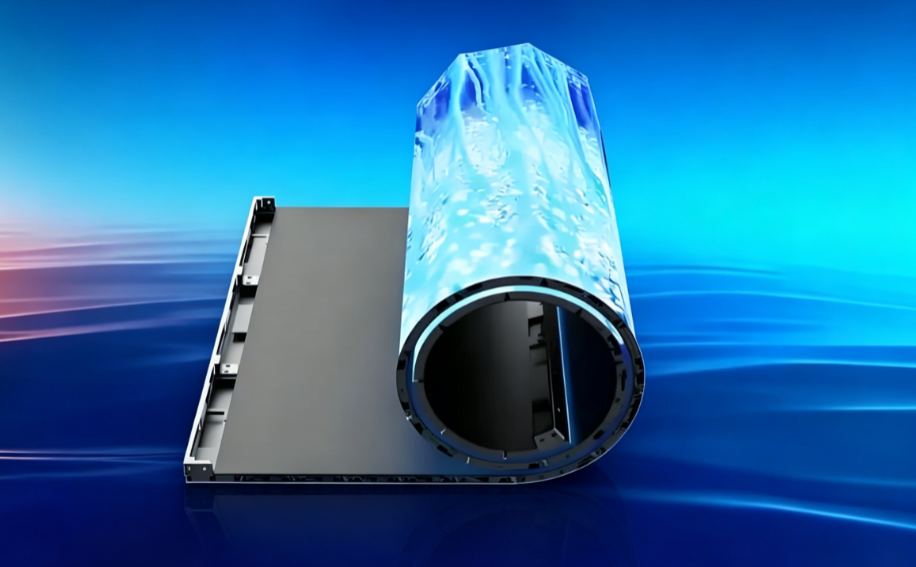
When unfolded, the screen’s thickness is typically kept within a few millimeters, and its weight per square meter is only one-third to one-fifth that of traditional LED screens, significantly reducing the load-bearing requirements on the mounting structure.
In terms of display performance, the Yobole LED roll-up screen inherits the high-brightness characteristics of traditional LED displays—indoor models reach 800–1,200 cd/m², while outdoor models reach as high as 3,000–5,000 cd/m², with a viewing angle exceeding 160°. Power consumption is reduced by approximately 20%–30% compared to traditional LED screens, and the LED chips have a service life of over 50,000 hours, striking a balance between visual impact and cost-effectiveness.
Even more critical is the efficiency of switching between the two states. LED roll-up screens are typically equipped with one-touch control for raising and lowering, with a response delay of less than 0.1 seconds. For scenarios requiring frequent changes in display status—such as retracting the screen after a shopping mall closes or quickly dismantling the setup after an event—this ability to “expand and retract at will” is precisely where its core value lies.
Why are LED roll-up screens hailed as the “magicians” of spatial design?
Traditional display screens have long faced three structural pain points in spatial design, and LED roll-up screens effectively address each one.
Pain Point 1: Fixed Screens Take Up Space
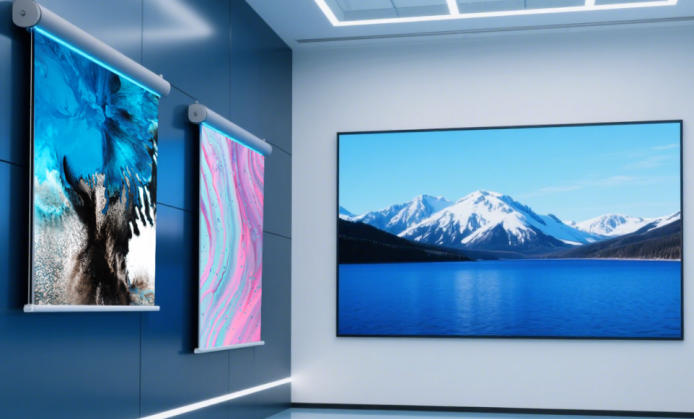
Once installed, traditional LED screens permanently occupy physical space and serve as the visual focal point of the area. In contrast, roll-up LED screens can be deployed and retracted as needed. For brand stores that require periodic changes to their visual displays, or for temporary exhibitions seeking an immersive experience, this “deploy when needed, retract when not in use” feature is extremely appealing. It eliminates the hassle of maintaining a “dedicated warehouse.”
Challenge 2: Bulky Screens and High Costs for Disassembly, Transportation, and Installation
Dismantling, transporting, and installing traditional LED screens are major undertakings—requiring large transport vehicles, specialized lifting equipment, and a coordinated effort by multiple people. In contrast, LED roll-up screens weigh only about one-third as much as traditional screens. Paired with lightweight mounting brackets, the entire process—from unboxing to powering on—can be completed in just two hours. For scenarios requiring frequent venue changes, such as touring performances and pop-up events, this lightweight advantage directly translates into cost savings.
Challenge 3: Screens Must Be “Flat” and Cannot Adapt to Irregular Spaces
Shopping mall columns, curved walls, irregular ceilings—traditional flat screens are helpless in the face of these spaces. LED roll-up screens, however, do not need to be fixed to a rigid frame; they can adapt to curved surfaces with a certain degree of curvature and even bend to conform to the shape of the object. Based on flexible LED modules, roll-up screens can precisely adapt to complex shapes such as circular and wavy designs, allowing the screen to truly “blend into” the space rather than “occupy” it.
It can be said that LED roll-up screens transform the screen from a “space occupier” into a “space liberator”—which is precisely where its nickname, “The Magician,” comes from.
LED Roll-Up Screens vs. Flexible Displays
Although both are “bendable” screens, LED roll-up screens are not the same as ordinary flexible displays. While both fall under the category of flexible displays, there are significant differences in their product positioning, form factors, and applicable scenarios.
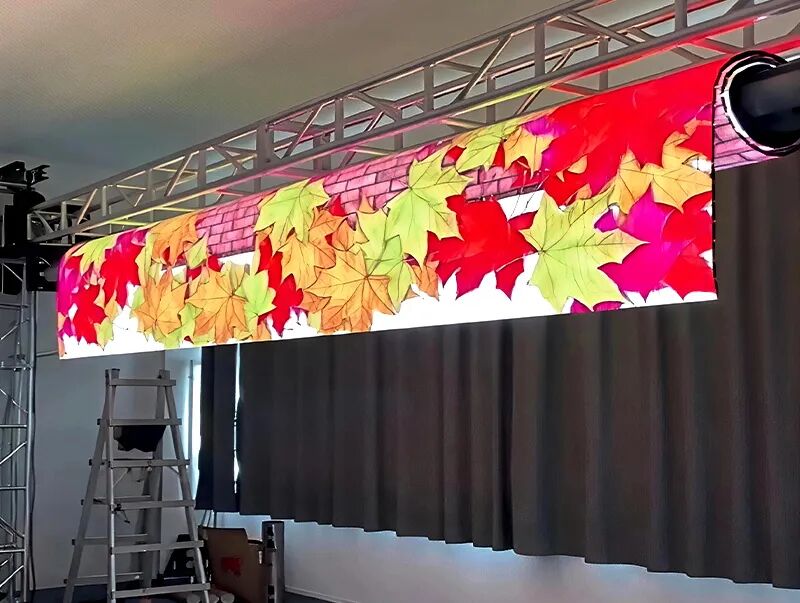
Standard flexible LED displays use flexible PCBs and silicone backings, allowing them to be installed on curved walls, columns, and other irregular surfaces; their core value lies in their “adaptability to irregular installations.” LED roll-up screens, however, build upon this foundation by adding a complete retraction mechanism and storage logic—they must not only “bend” but also “roll up and unfold.” If standard flexible displays represent a material technology, then LED roll-up displays constitute a complete, systematic product.
Once installed, standard flexible displays typically maintain a fixed shape—they can be bent into an arc but lack the ability to “retract.” In contrast, the core design logic of LED roll-up displays is “rollable and deployable”: they are rolled into a cylinder for storage when not in use and quickly deployed when needed. This “effortless retraction and deployment” feature gives LED roll-up screens a level of spatial flexibility that ordinary flexible displays lack.
Ordinary flexible displays are better suited for long-term, fixed installations in non-standard shapes—such as curved walls in exhibition halls or cylindrical screens in commercial spaces—while LED roll-up screens are better suited for scenarios that demand high space utilization and rapid deployment: trade shows, pop-up stores, touring stages, and temporary events.
In short, standard flexible displays are solutions for “fixed, non-standard shapes,” while LED roll-up screens are solutions for “mobile, non-standard shapes with on-demand deployment and retraction.” Each has its own specific applications, and the two should not be conflated.
Industry Trend Forecast
Based on market data and technological advancements, LED roll-up screens are currently on an upward trajectory. From a macro industry perspective, the global flexible display market is projected to reach $55.9 billion by 2025. Breaking this down to the LED flexible display segment, the global market size is expected to reach $4.59 billion in 2024, with a compound annual growth rate (CAGR) of 17.3%. Within the creative LED display category, global sales reached 13.1 billion yuan in 2025, and the industry is projected to reach 24.9 billion yuan by 2032. As a product category at the intersection of creative and flexible displays, LED roll-up screens benefit from the dual growth of these two major sectors.
In terms of technological evolution, Yobole LED roll-up screens are continuously making breakthroughs toward higher resolution, lower energy consumption, and longer service life. The maturation of the GOB packaging process has achieved an IP65 protection rating, ensuring stable operation even in challenging environments; intelligent light-sensing chips automatically adjust brightness based on ambient light, while dynamic energy-saving drivers further reduce power consumption by 35% to 50%. With the widespread adoption of COB flip-chip packaging and other processes, the dead-pixel rate has been controlled to below 0.001%, and image quality and reliability continue to improve.
Currently, the application of LED roll-up screens is expanding from rental venues such as exhibitions and stages to commercial spaces, cultural and tourism night tours, and architectural decoration. In the future, with the integration of IoT and AI technologies, roll-up screens are expected to achieve smarter content management and environment-adaptive displays, evolving from “display terminals” to “spatial visual infrastructure.”
From “rolling up” to “unfolding,” LED roll-up screens are transforming not only the form of the screen but also the relationship between the display and the space. They use flexible substrates to break the rule that screens “must be flat,” employ lightweight designs to address the pain point of being “bulky and difficult to move,” and respond to the need for “every inch of space to be valuable” with their ability to roll up and unfold at will. Compared to ordinary flexible screens, the core competitiveness of LED roll-up screens lies in their ability to “roll up”—for the first time, they give screens the capability to “disappear at any time and reappear at any time.”
相关新闻
-
A Beginner's Guide to LED Displays: From Principles to Applications
As semiconductor manufacturing processes continue to mature, the pixel pitch of LED displays is becoming smaller and their resolution higher, leading to an ever-expanding range of applications for LED displays.
-
What is the optimal viewing distance for different LED screens?
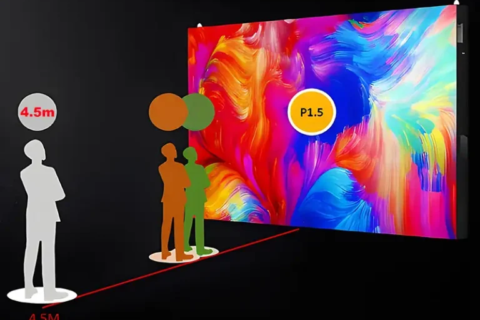
The viewing distance for an LED display can be accurately estimated based on the pixel pitch; the minimum viewing distance is 1 times the pixel pitch, and the optimal viewing distance range is between 1 and 3 times the pixel pitch.
-
How Can You Tell if an LED Display Is Good or Bad?
The quality of an LED display hinges on its long-term operational reliability, which is primarily determined by five core components: the LED chips must be highly stable, and the cabinet must be sturdy and provide effective heat dissipation, among other factors. These factors also serve as important considerations for users when making a purchase.
-
What is a monochrome LED display?
A monochrome LED display is a display device consisting of a dot matrix formed by single-color LED chips. By using a control system to regulate the on/off status and brightness of each LED chip, it displays content such as text and graphics.
-
What is the GOB Process?
The GOB process supports a wide range of LED displays, including fine-pitch LED displays, ultra-rugged rental LED displays, ultra-rugged floor-standing interactive LED displays, and ultra-rugged transparent LED displays.