

What is a monochrome LED display?
1. What Is a Monochrome LED Display?
A monochrome LED display, as the name suggests, is a screen composed of LED diodes of a single color arranged in a dot matrix to display text, graphics, and even simple animations. Common colors include red, green, and yellow, with red being the most common due to its high luminous efficiency and brightness.
You can think of it as a “canvas” made up of countless tiny light bulbs; by controlling whether each bulb is on or off and adjusting its brightness, you can display various types of information. While it doesn’t offer the rich color palette of a TV or smartphone screen, monochrome displays are practical enough for many applications and are generally more cost-effective and reliable.
Core Components:
Monochrome LED chips: These are small light-emitting components that can only emit light of a single color; different materials and manufacturing processes allow them to produce colors such as red, green, and yellow.
Control system: This acts as the screen’s “brain,” responsible for receiving external information and converting it into instructions that control the on/off status and brightness levels of each LED.
Control software: A user interface installed on a computer or smartphone that is used to edit and manage the content to be displayed, which is then sent to the screen via the system.
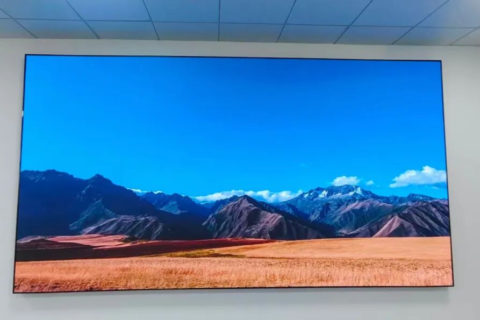
2. How Does It Work?
The principle is actually quite simple and can be broken down into two main aspects:
2.1. LED Matrix Arrangement
The LEDs on the screen are neatly arranged in rows and columns, much like a chessboard. Each LED represents a “pixel”; the denser the arrangement (i.e., the smaller the pixel pitch), the more detailed and clear the displayed image will be.
2.2. Control System Operation
When you input text or an image via software, the control system processes it as follows:
- The processor receives and parses the signal;
- The driver chip, following the instructions, controls the LEDs at corresponding positions to turn on or off, or adjust their brightness;
- Multiple LEDs work in unison to ultimately form the complete text or graphic.
The entire process is fast and precise, refreshing dozens or even hundreds of times per second, resulting in a stable and clear image to the naked eye.
3. Key Parameter Explanations
When purchasing or selecting a monochrome LED display, you’ll often encounter several technical terms that directly affect the screen’s performance. Here’s a simple explanation of each:
3.1. Pixel Pitch (Unit: mm)
This refers to the distance between the centers of two adjacent LED chips. The smaller the value, the denser the chips and the finer the image; the larger the value, the more suitable it is for viewing from a distance. The typical range is between 2 mm and 10 mm; use a smaller pitch for close viewing and a larger pitch for viewing from a distance.
3.2. Brightness (Unit: nit)
Simply put, this is the screen’s “brightness level.” The higher the brightness, the clearer the image appears in direct sunlight. Indoor use generally requires 1,000 to 2,000 nits, while outdoor use in bright sunlight requires 3,000 to 5,000 nits or even higher.
3.3. Refresh Rate (Unit: Hz, Hertz)
This indicates how many times per second the screen updates its image. The higher the refresh rate, the smoother the image appears, and the less likely it is to flicker. Generally, a minimum of 60 Hz is required; high-quality screens can reach 1,920 Hz or higher, ensuring no streaking occurs when taking photos or recording video.
3.4. Viewing Angle (Unit: degrees)
This refers to the range of angles from which the image remains clear when viewed from the side. A wider viewing angle means viewers standing to the side can still see clear content. Typically, monochrome screens have a viewing angle of 120 degrees or more, which is sufficient to meet viewing needs in most situations.
4. Major Application Scenarios
Due to their low cost, high brightness, and durability, LED monochrome displays are widely used in:
Advertising: Storefront signs, outdoor billboards, and shopping mall promotional displays;
Traffic Guidance: Variable message signs on highways, parking lot directional displays, and bus stop signs;
Information Displays: School bulletin boards, hospital call-number screens, and bank exchange rate and interest rate displays;
Sports Venues: Scoreboards, timers, and audience guidance information.
5. Summary
Although LED monochrome displays can only show a single color, they still play a vital role in numerous professional and commercial settings thanks to their high brightness, low power consumption, long lifespan, and affordability. With a clear operating principle, relatively simple structure, and easy maintenance, they represent a highly mature display solution. By understanding the key parameters outlined above by Yobole, you can select the most suitable screen based on your actual needs. Yobole is a globally leading provider of LED display solutions, with its core business focused on advertising displays, stage displays, commercial displays, data visualization displays, conference displays, creative led displays, and smart city applications. Its products are exported to more than 100 countries and regions worldwide. To date, the company has successfully completed over 10,000 landmark projects, accumulating extensive industry experience and earning deep market trust. Looking ahead, Yobole will continue to expand its global footprint and accelerate the implementation of emerging applications such as AI+display, XR virtual production, and smart lighting displays. By harnessing the technological power of light and shadow, Yobole aims to empower the global visual industry to move toward a smarter and more spectacular future.
相关新闻
-
A Beginner's Guide to LED Displays: From Principles to Applications
As semiconductor manufacturing processes continue to mature, the pixel pitch of LED displays is becoming smaller and their resolution higher, leading to an ever-expanding range of applications for LED displays.
-
What is the GOB Process?
The GOB process supports a wide range of LED displays, including fine-pitch LED displays, ultra-rugged rental LED displays, ultra-rugged floor-standing interactive LED displays, and ultra-rugged transparent LED displays.
-
How Can You Tell if an LED Display Is Good or Bad?
The quality of an LED display hinges on its long-term operational reliability, which is primarily determined by five core components: the LED chips must be highly stable, and the cabinet must be sturdy and provide effective heat dissipation, among other factors. These factors also serve as important considerations for users when making a purchase.
-
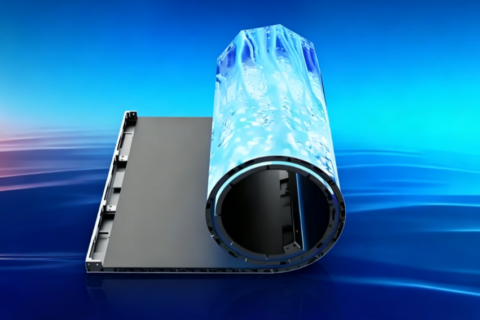
Why Are LED Roll-Up Screens So Popular?
The key to the roll-up storage capability of LED roll-up screens lies in the flexibility of their materials. They use thin-film substrates or flexible materials such as polymers to replace traditional rigid PCBs, with the LED chips and driver circuits mounted on a bendable substrate.
-
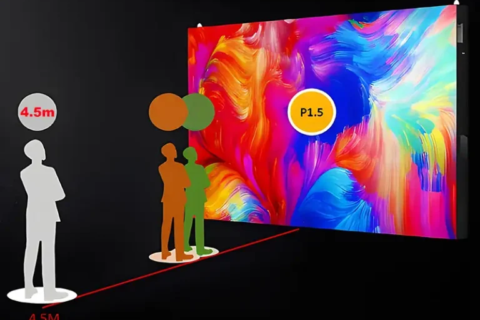
What is the optimal viewing distance for different LED screens?
The viewing distance for an LED display can be accurately estimated based on the pixel pitch; the minimum viewing distance is 1 times the pixel pitch, and the optimal viewing distance range is between 1 and 3 times the pixel pitch.