

A Beginner's Guide to LED Displays: From Principles to Applications
In today’s information society, visual communication is everywhere. People’s expectations for display devices are also rising—they must not only be responsive, feature vibrant colors, and produce vivid images, but also be large enough to deliver a stunning visual experience. With the rapid advancement of microelectronics and computer technology, the manufacturing processes for LED displays have become increasingly sophisticated, resulting in smaller pixels and sharper image quality. Today, the three primary colors—red, green, and blue—have been integrated into a single pixel to achieve full-color display, enabling LED screens to be widely used in various settings.
What Is an LED?
LED stands for “Light Emitting Diode,” a type of semiconductor material capable of converting electrical energy into light energy. By selecting different materials, LEDs can emit light in a variety of colors, including red, green, blue, and yellow. It is precisely because LEDs possess the following advantages that they have become the technology of choice for large-screen displays:
- High brightness: Currently, the brightness of a single outdoor LED can approach 6,000 millicandelas (mcd), making it clearly visible even in direct sunlight.
- Low energy consumption: With high photoelectric conversion efficiency, LEDs are more energy-efficient than traditional display devices.
- Long lifespan: LEDs can last for over 200,000 hours, equivalent to continuous operation for more than 22 years.
- Fast response: Response times reach the nanosecond (ns) range, with virtually no delay or motion blur.
- Easy to control: Driven by low voltage and low current, they offer excellent compatibility with computer interfaces, facilitating intelligent control.
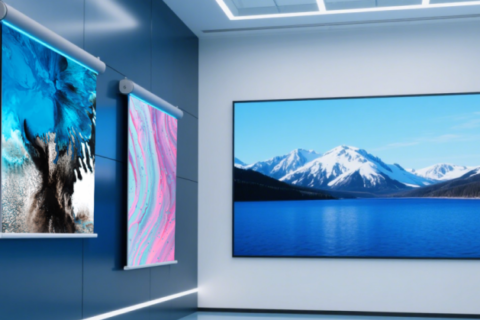
Advantages of LED Displays
Compared to other large-screen display technologies, LED displays offer the following notable features:
- Flexible Sizing: Screens can be scaled to any size; currently, the largest can exceed 500 square meters, with virtually no size limitations.
- Wide Viewing Angle: Indoor screens have a viewing angle greater than ±80 degrees, while outdoor screens exceed ±60 degrees, ensuring clear visibility even when viewed from the side.
- Adjustable Viewing Distance: By selecting different pixel diameters and pixel pitches, the viewing distance can be adjusted from tens of centimeters to hundreds of meters, making them suitable for a wide range of applications. Currently, the smallest pixel diameter has reached 1.9 millimeters.
- Versatile Configurations: From simple numeric displays to complex full-color video, there are corresponding products to meet various needs, suitable for both indoor and outdoor use.
- Strong Compatibility: Easy to connect to computers and supports a wide range of software operations.
Comparison of LED Displays with Other Large Screens
To help you better understand the characteristics of various large screens, the table below briefly compares several common display technologies:
| Screen Type | Advantages | Disadvantages |
|---|---|---|
| Magnetic Flip-Panel | Low power consumption | Slow response time, cannot display video, high failure rate |
| Video Wall | Full-color display | Seams, low brightness, not suitable for displaying text, cannot be used outdoors |
| Projection | Full-color, detailed image | Low brightness, difficult to see outdoors, poor image uniformity |
| CRT | Full-color | High cost, high power consumption, limited screen size |
| PDP (Plasma) | Full-color, detailed image | High cost, narrow viewing angle, limited screen size |
Classification of LED Displays
LED displays can be classified based on application scenarios, display colors, and functional purposes.
Classification by Application: Indoor and Outdoor Displays
Indoor LED Displays: Made by assembling light-emitting crystals into dot matrix modules or digital tubes, which are then joined to form panel units and finally combined as needed to create a complete screen. Common specifications based on pixel diameter include Ф2, Ф3, Ф3.75, Ф4.8, Ф5, Ф8, and Ф10.
Outdoor Screens: First, light-emitting crystals are encapsulated into individual LED lamps (often equipped with reflectors to enhance brightness). Multiple LED lamps are then combined into pixel tubes or modules, and these modules are finally assembled into cabinet units. The cabinets are sealed to provide waterproofing and anti-fog capabilities, ensuring they can withstand complex outdoor weather conditions. Common specifications include Ф11, Ф14, Ф16, Ф19, Ф21, Ф26, and Ф36.
Classification by Display Color: Monochrome, Bicolor, and Full Color
Single Primary Color: Each pixel displays only one color; the most common is red (due to its high luminous efficiency), though green or mixed colors (a combination of red, green, and yellow) are also available.
Two-primary-color: Each pixel contains two colors—red and green—which can be overlaid to produce yellow. With grayscale control, adjusting the brightness of these two colors allows for a maximum of 65,535 colors.
Full color (three primary colors): Each pixel consists of three primary colors—red, green, and blue. Combined with grayscale control, this can reproduce the vast majority of colors found in nature, with a total of 16,777,216 colors (i.e., over 16 million colors).
Classified by Function and Purpose: Bar Screens, Text-and-Graphics Screens, Video Screens, Digital Screens, and Hybrid Screens
Bar Screens: Primarily used to display text, these screens come with a built-in font library and allow for remote input or message transmission via a computer; they support offline operation. They are called “bar screens” because they are typically long and narrow in shape.
Text-and-Graphics Displays: Used to display text and simple graphics; they generally lack grayscale control, and content is input via a computer. Compared to bar displays, they offer a wider variety of fonts and graphics; compared to video displays, their advantage lies in the ability to control multiple screens with a single computer, and they support offline display.
Video Displays: Each pixel corresponds one-to-one with a computer monitor; they feature grayscale control and offer strong visual expression. When paired with a multimedia card, they can play video signals and display computer screens in real-time synchronization.
Digital Display: Lower in cost, these are widely used in scenarios such as displaying bank exchange rates and interest rates, as well as seafood and room rates in hotels. They are typically supplemented by strip displays to provide additional text information.
Hybrid Display: This combines dot-matrix and digital display technologies and is most commonly found in applications requiring the simultaneous presentation of both numeric and text information, such as stock market tickers.
We hope this article compiled by Yobole helps you more easily understand the basics of LED displays. Yobole is a globally leading provider of LED display solutions, with a primary focus on advertising displays, stage displays, commercial displays, data visualization displays, conference displays, creative displays, and smart city applications. Our products are exported to more than 100 countries and regions worldwide. To date, we have successfully completed over 10,000 landmark projects, accumulating extensive industry experience and earning deep market trust. In the future, Yobole will continue to expand its global footprint, accelerate the implementation of emerging applications such as AI+display, XR virtual production, and smart lighting displays, and use the power of light and shadow technology to empower the global visual industry to move toward a smarter and more spectacular tomorrow.
相关新闻
-
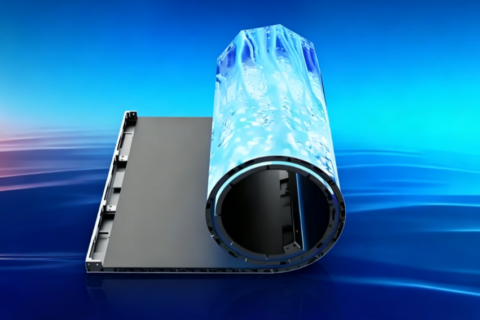
Why Are LED Roll-Up Screens So Popular?
The key to the roll-up storage capability of LED roll-up screens lies in the flexibility of their materials. They use thin-film substrates or flexible materials such as polymers to replace traditional rigid PCBs, with the LED chips and driver circuits mounted on a bendable substrate.
-
How Can You Tell if an LED Display Is Good or Bad?
The quality of an LED display hinges on its long-term operational reliability, which is primarily determined by five core components: the LED chips must be highly stable, and the cabinet must be sturdy and provide effective heat dissipation, among other factors. These factors also serve as important considerations for users when making a purchase.
-
What is a monochrome LED display?
A monochrome LED display is a display device consisting of a dot matrix formed by single-color LED chips. By using a control system to regulate the on/off status and brightness of each LED chip, it displays content such as text and graphics.
-
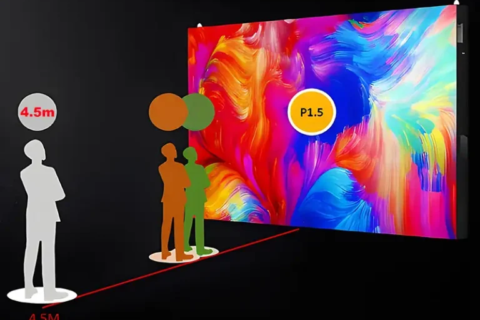
What is the optimal viewing distance for different LED screens?
The viewing distance for an LED display can be accurately estimated based on the pixel pitch; the minimum viewing distance is 1 times the pixel pitch, and the optimal viewing distance range is between 1 and 3 times the pixel pitch.
-
What is the GOB Process?
The GOB process supports a wide range of LED displays, including fine-pitch LED displays, ultra-rugged rental LED displays, ultra-rugged floor-standing interactive LED displays, and ultra-rugged transparent LED displays.